Promise or Proof: The Question Every Love Eventually Becomes

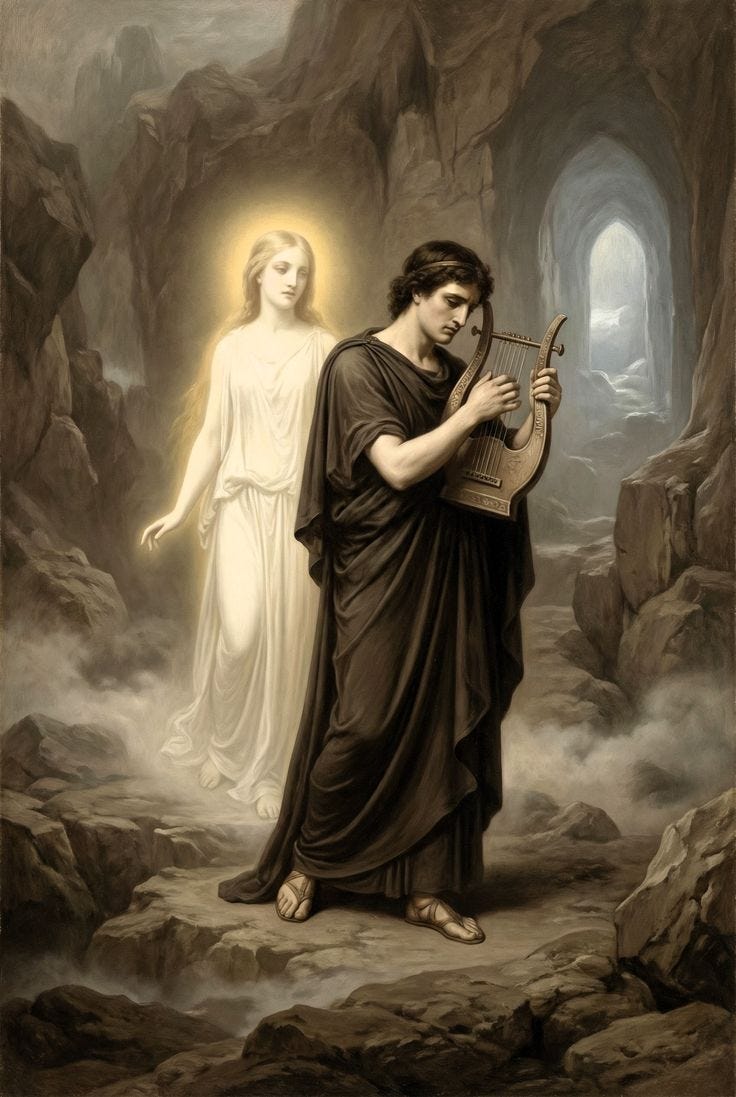
There is a version of the myth where Orpheus almost makes it.
That detail matters to me.
He does not fail immediately. He does not panic at the entrance. He does not crumble in the dark. He walks almost the entire way out of the underworld with Eurydice behind him. Almost to the mouth of light. Almost to warmth. Almost to air that belongs to the living.
Almost.
And that almost is more devastating than failure.
Because it means he endured the worst part.
He endured the silence.
He endured the rule.
He endured the way love feels when it is present but unverifiable.
People simplify the story into a moral. Trust more. Doubt less. But that reading feels lazy. What actually happens is much more intimate, much more violent.
He is told she is behind him. He is told she is following. He is told that if he does not look back, she will live.
That sounds simple until you imagine walking with your entire heart positioned somewhere you are forbidden to see.
Love is not an idea. It is orientation. When you love someone, your body aligns toward them automatically. Even in sleep, people turn toward the person they trust most. Even in crowded rooms, your senses filter for one voice.
To love is to locate.
Now imagine being asked to move forward without locating.
How do you not turn back?
Not metaphorically. Physically. How do you prevent your neck from obeying instinct? How do you keep your shoulders square when your whole nervous system is asking for confirmation?
Because that is what this is about. Confirmation.
We talk about trust as if it is purely moral, as if it floats above the body. But trust is biological. It is built through repetition, through sight, through touch, through feedback. The brain regulates itself by proving over and over again that what it loves still exists.
Even physics is honest about this. Observation changes systems. Measurement affects outcome. Nothing remains untouched by attention.
And yet Orpheus is told not to observe.
Walk as if you do not need proof.
Walk as if love can remain intact without your eyes on it.
That is not a test of faith. It is a demand for detachment.
And here is where the story becomes unbearably modern.
We pretend not to check. We pretend not to care. We pretend that needing reassurance is weakness. We rehearse composure like it is maturity. We learn to walk forward without looking back because looking back feels embarrassing.
But embarrassment is not the same as doubt.
It is possible to love someone so fiercely that you would descend into death for them and still need to see their face in the dark. It is possible to trust them and not trust the conditions.
Because here is the quieter, sharper question no one asks.
Why does this love require blindness to survive?
Why is the miracle conditional?
If Eurydice is truly behind him, if the gods are honest, if the path is real, then why should one glance undo it all?
How do you not turn back when the rule itself feels cruel?
And we have to sit inside the fact that this is his last chance. There is no second negotiation. No second descent. No revision.
The entire future of his love is contained in the angle of his spine.
He is almost at the surface. Light is thinning the dark. Air is changing temperature. The exit is close enough to feel.
But silence stretches.
And silence is dangerous.
Silence invites imagination. Silence invites doubt. Silence invites the terrible thought that she is not there anymore.
How do you not turn back when the cost of turning is everything and the cost of not turning might be living forever with uncertainty?
Because that is the real tension.
If he keeps walking and she is gone, he will only discover it once he reaches the light. He will have obeyed perfectly for nothing.
If he turns and she vanishes, he loses her because he needed to see her.
Both paths contain loss.
So the myth is not about doubt. It is about which loss you can endure.
The loss of her.
Or the loss of knowing.
There is something almost unbearably romantic about the idea that he could not tolerate abstraction. That he could not treat her like a promise behind him. That he loved her in a way that demanded presence, not potential.
And there is something equally powerful about the alternative, about walking forward with composure, believing that what belongs with you will remain without surveillance.
Coolness is not indifference. It is containment.
How do you not turn back?
You decide that the future matters more than reassurance. You decide that if love is real, it will meet you in the light.
But how do you turn?
You decide that reality matters more than obedience. You decide that if love cannot survive being seen, it was already fragile.
This is why the myth lasts.
Not because he failed.
But because the choice is unbearable.
And if I strip away philosophy, strip away poetry, strip away interpretation, what remains is something simple and human.
He wanted to see her.
He wanted her face.
He wanted to confirm that the body he loved was not a story told by gods in the dark.
And maybe that is not weakness.
Maybe that is the most honest thing in the entire story.
How do you walk away without knowing your loved one is with you?
Maybe you do not walk away. Maybe you walk toward something, toward light, toward air, toward a future, and trust that if they belong beside you, they will close the distance without being summoned.
Or maybe you turn.
Because you refuse to build your life on an echo.
I do not know which is braver.
I only know that the smallest movement of his neck has outlived empires.
Because in that movement lives the most dangerous question love can ask.
Do you want the promise or do you want the proof?
And how do you not turn back when your whole heart is walking behind you?